
Math
Welcome to Midwood's Math & Computer Science Department
A Little Bit About Us
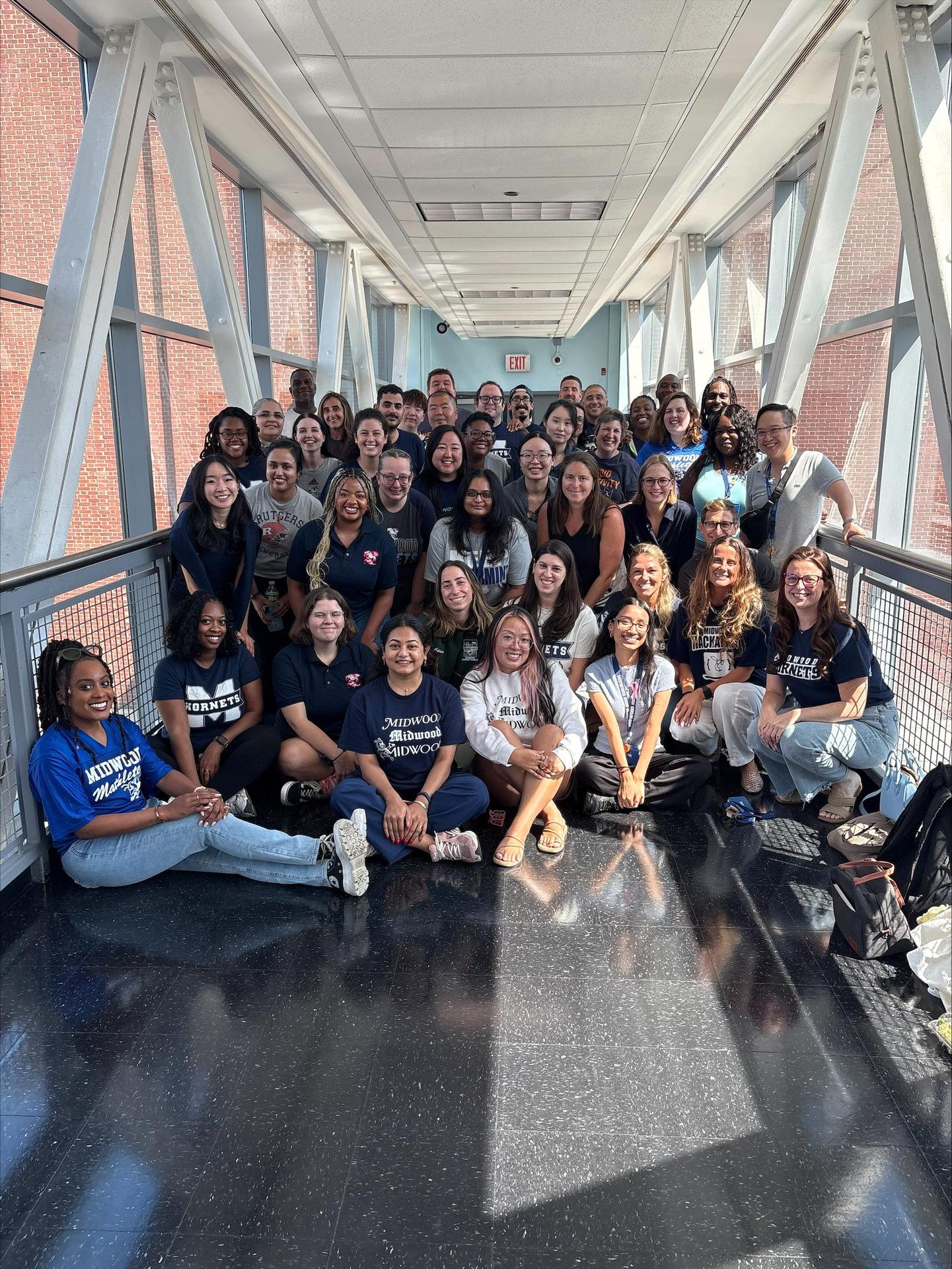
We offer a wide variety of classes in the Mathematics Department which extends to Advanced Placement courses in Calculus, Statistics and Computer science. The department consists of approximately 33 general education and 10 special education teachers who are dedicated to the success of our students. We look forward to an exciting school year.
Advanced Placement and Elective Courses
Offered in the Mathematics Department
BC Calculus: AP Calculus BC is a double-period course which focuses on students’ understanding of calculus concepts and provides experience with methods and applications. Through the use of big ideas of calculus (e.g., modeling change, approximation and limits, and analysis of functions), this course becomes a cohesive whole, rather than a collection of unrelated topics. AP Calculus BC requires students to use definitions and theorems to build arguments and justify conclusions. The course features a multi-representational approach to calculus, with concepts, results, and problems expressed graphically, numerically, analytically, and verbally. Exploring connections among these representations builds understanding of how calculus applies limits to develop important ideas, definitions, formulas, and theorems. A sustained emphasis on clear communication of methods, reasoning, justifications, and conclusions is essential. Students will regularly use technology to reinforce relationships among functions, to confirm written work, to implement experimentation, and to assist in interpreting results.
AB Calculus: AP Calculus AB is a single-period one year course designed to be the equivalent of the first semester of college calculus. The course culminates in the AP Calculus AB Exam. Students will apply their knowledge of Algebra, Geometry, and Trigonometry, and synthesize those with their knowledge of limits from Precalculus to gain a deeper understanding of functions. Students will work with numerical, algebraic, graphical and verbal representations of functions related to both real-world and theoretical applications. Students will work on challenging problems with and without technology, and they will explain their thinking in words and in formal mathematical notation.
AP Statistics: The AP course and exam in Statistics are offered to high school students who wish to complete studies equivalent to a one-semester, introductory, non-calculus-based, college course in statistics. An introductory statistics course, similar to the AP Statistics course, is typically required in college for majors such as social sciences, health sciences, and business. Science, engineering, and mathematics college majors usually take an upper-level calculus-based course in statistics, for which the AP Statistics course is effective preparation. Students who successfully complete the AP Statistics course and exam may receive credit, advanced placement, or both for a one-semester introductory college statistics course. This course is single-period for the entire school year.
AP Computer Science Principles: This course is designed to be equivalent to a first-semester introductory college computing course. In this course, students will develop computational thinking skills vital for success across all disciplines, such as using computational tools to analyze and study data and working with large data sets to analyze, visualize, and draw conclusions from trends. The course engages students in the creative aspects of the field by allowing them to develop computational artifacts based on their interests. Students will also develop effective communication and collaboration skills by working individually and collaboratively to solve problems, and will discuss and write about the impacts these solutions could have on their community, society, and the world. The course is single-period for the entire school year.
AP Computer Science A: This course introduces students to computer science with fundamental topics that include problem solving, design strategies and methodologies, organization of data (data structures), approaches to processing data (algorithms), analysis of potential solutions, and the ethical and social implications of computing. During the course, students learn how to write code in the programming language: Java. We explore many concrete topics and complete multiple projects throughout the year. Examples include creating a chat bot that responds to user input, creating an interactive Tic Tac Toe game, and redefining individual pixels of a picture to manipulate the image. This course is single-period for the entire school year.
Other electives:
Advanced Topics in Mathematics
Calculus
Introduction to Coding: PYTHON
CODING: Java Script
CODING: CSS/ HTML
Intro to Entrepreneurship (Business elective)
Personal Finance
Statistics
Virtual Enterprise (Business Elective)
Math Teams & How to learn more about them
For Math team information, contact Mr. David Lee or Ms. Sandy Wu
For Computer Science team information, contact Ms. Jordyn Akyuz or Ms. Janet Gillespie
For information about Virtual Enterprise/ Entrepreneurship, contact Mr. Jakub Karpieszuk
Assistant Principal:
Deepa Sivaprakash, IA
Math Teachers:
Jordyn Akyuz
Shahibun Alam
Allison Anderson
Amy Brenner
Lisa Bueno
Mamie Chu
Misael Cordova
Jasper DeAntonio
Meghana Dutta
Lawrence Evans
Giovanni Gil
Janet Gillespie
Renee Goldfarb
Jason Greenbaum
Tyniqua Hinton
Nicole Hird
Jessica Hyun
Jakub Karpieszuk
Stanley Kong
David Lee
Oleg Leocumovich
Sarah Lobotsky
Maysoon Mansour
Lauren McEvoy
Jessica Pan
Julie Schram
Bryann Scioli
SueAnn Seccafico
David Walters
Samantha Wetherill-
Copeland
Sandy Wu
Guo Xin Zhou
Special Education:
Kristina Boswell
Courtney Daub
Megan Deslouches
Emily Duong
Edward Giordano
Adam Gross
Mikaela Henry
Leeba-Keller Johnson
Ayanbola Lawal
Kelli McDermott
Jonathan Rafferty
Lisa Shammas